An MVP is a concept refined over the history of software. In short, an MVP enables customer discovery in the quickest time frame with minimum effort. Today, most teams approach new products this way — and the approach applies to almost any kind of business, not just software.
What is an MVP?
We define an MVP as the unique product that maximizes return on risk for both the vendor and the customer.
A Minimum Viable Product is the basic version of a product that can still be released to the market and provide value to customers. It typically includes only the core features necessary to solve the main problem or address the primary need of users.
The purpose of an MVP is to quickly test a product's usability, gather feedback and iterate based on that feedback. This lets you minimize cost and time to market while ensuring you build something your target audience actually needs.
Teams often get carried away, putting too much into the first release without considering the risk. A company building an AI chatbot, for example, could invest heavily up front — or ship the simplest version, watch how customers use it, and improve from there. That customer-centric loop is the heart of the MVP approach.
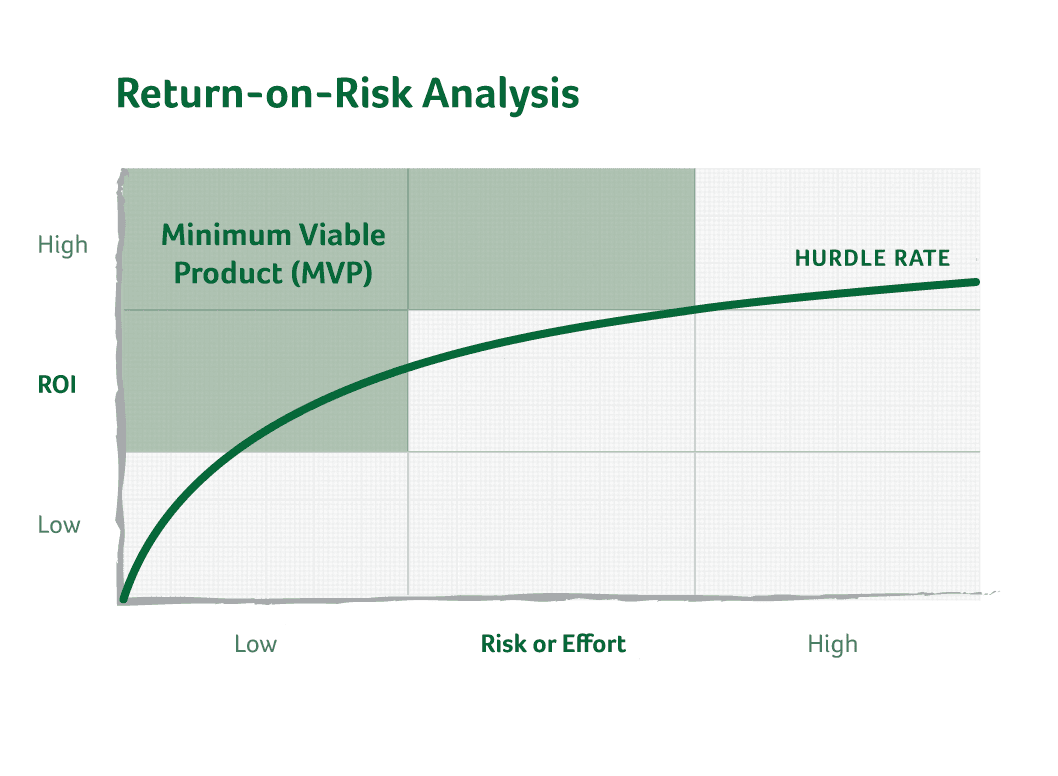
Put simply, the MVP is the sweet spot in the upper-left quadrant: high ROI on the vertical axis, low risk (and low effort and time to market) on the horizontal axis.
Minimum Viable Product benefits
The MVP balances the need for essential features against the risk of overwhelming complexity. Products lacking key features fail quickly; products with too many features face diminished returns and higher risk for both seller and buyer.
The return-on-risk ratio drops sharply as features pile up. Every extra use case must be designed, tested and fixed — increasing complexity, QA cost and time to market for the vendor, and adoption time, training and dissatisfaction for the customer.
SyncDev offers a systematic approach to defining the MVP, combining proven methods with direct customer interaction so the product meets essential needs without unnecessary complexity.
How to create an MVP
Creating an MVP involves a few clear steps to make sure you build something valuable with minimal resources:
- Identify the problem. Understand the problem you are solving and who your target customers are.
- Define the core features.Determine the essential features needed to address the problem — only what's necessary for the first version.
- Prototype. Create a mockup to visualize how it will work and gather early feedback.
- Develop. Build the MVP with the core features. Keep development lean and focused on delivering value quickly.
- Test and gather feedback. Release to a small group of users and document how they interact and what they suggest.
- Iterate. Prioritize improvements based on user feedback and adjust the product.
- Launch. Once refined, release to a wider audience and keep monitoring real-world usage.
- Measure success. Track metrics such as engagement, retention and conversion to guide future iterations.
Remember: the goal of an MVP is to validate your idea with minimal resources and iterate from real-world feedback. Keep the focus on delivering value and refining over time.